Loading

Loading

NFPA 72 FIRE ALARM & SIGNALING CODES —— A Complete Guide for Pakistan’s Fire Safety Professionals

Introduction: Why Fire Alarm Systems Matter

Modern buildings are complex, populated, and technology driven. Protecting lives and property requires more than extinguishers or sprinklers — it demands early detection and reliable notification systems.
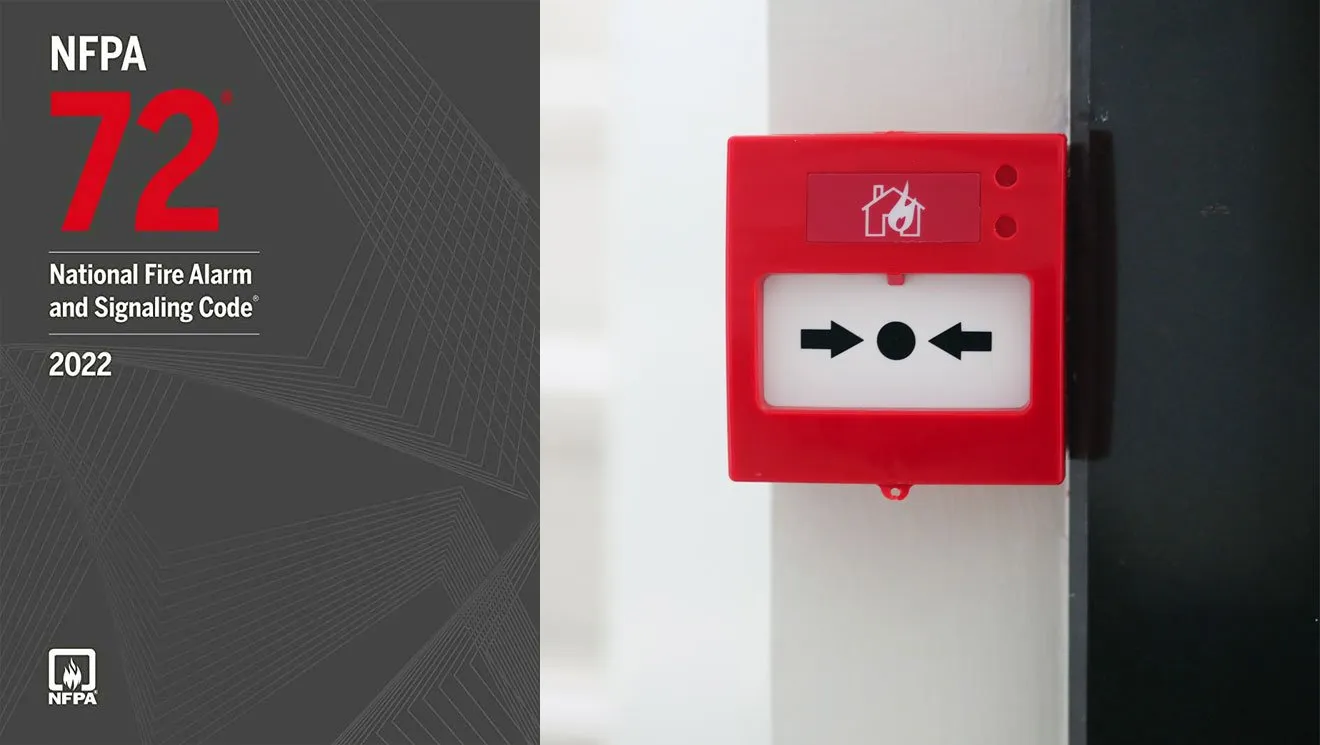
The NFPA 72 – National Fire Alarm and Signaling Code provides the international benchmark for design, installation, and maintenance of these systems.
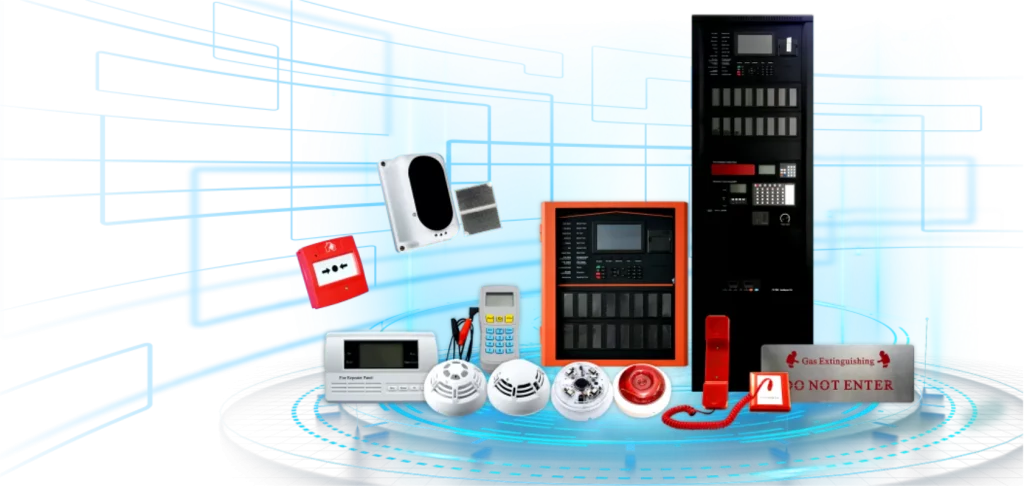
In Pakistan, the Building Code of Pakistan – Fire Safety Provisions 2016 legally mandates that all significant occupancies follow fire alarm and detection requirements consistent with NFPA standards.

This comprehensive post explains both standards, walks through real design logic, and highlights practical examples for professionals. It also introduces Excel Industrial Services (EIS) — one of Pakistan’s most reputable suppliers and integrators of NFPA-compliant fire alarm systems.


Understanding NFPA 72 — The Global Fire Alarm Standard
1. Origin and Development

NFPA 72 evolved from early 20th-century signaling standards.

  • 1898: Committee on Thermo-Electric Fire Alarms formed.
  • 1993: Multiple standards merged into one comprehensive code.
  • 2010: Emergency Communication Systems (ECS) added.
  • 2022: Cybersecurity, remote access, and visual tagging introduced.

2. Code Purpose

NFPA 72 defines how fire alarm and communication systems must be designed, installed, tested, and maintained once required by a building or fire code. It guarantees consistent reliability and interoperability.
3. Structure Overview

CategoryContent
Admin Chapters (1–9)Scope, definitions, responsibilities
Support Chapters (10–12)Fundamentals, wiring, power supplies
System Chapters (17–29)Devices, notification, communication, monitoring
Annexes (A–I)Explanatory notes and best practices

Fire Alarm Requirements from the Building Code of Pakistan (Fire Safety Provisions 2016)

The Pakistan Engineering Council’s 2016 code adapts global NFPA standards to local conditions.

Key Enforcement Points

  • Every new building, renovation, or change of occupancy must meet fire safety provisions (Clause 3.1).
  • Approval and inspection authority: local Building Control Authority, Civil Defense, or Cantonment Board (Clause 1.4).
  • Violations constitute breaches of engineering practice (Clause 1.2).

Chapter 9 — Detection, Alarm & Communication Systems
Highlights from Section 9.7:

  • Educational Occupancies (9.7.2.3): Smoke detectors in all corridors and rooms; CO detectors near fuel appliances.
  • Day-Care (9.7.2.5): Automatic and manual systems; detectors in playrooms, corridors, and sleeping areas.
  • Health Care (9.7.2.7): Corridor and patient-room detection, staff-station pull points.
  • Detention (9.7.2.9): Detection in cells, common, and sleeping areas.
  • Residential (9.7.2.11–12): Smoke alarms in every bedroom, corridor, and level; interconnection required for new dwellings.
  • Business (9.7.2.23–24): Fire alarm mandatory for 3-plus-story or high-occupant buildings.
  • High-Rise (9.7.2.27): Voice Evacuation System + Automatic Detection required.

Integration with NFPA 72

The Building Code explicitly references NFPA 1 (2015) and NFPA 72 (2013 / 2016 editions) as technical bases for design and performance.


Core Design Concepts under NFPA 72
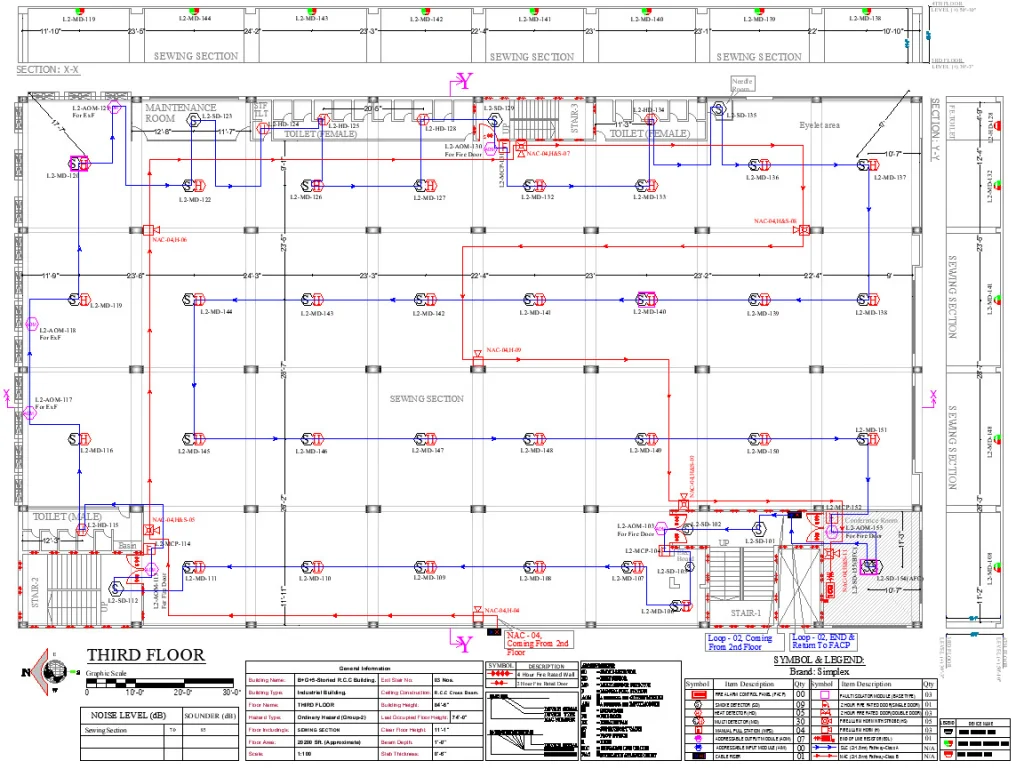
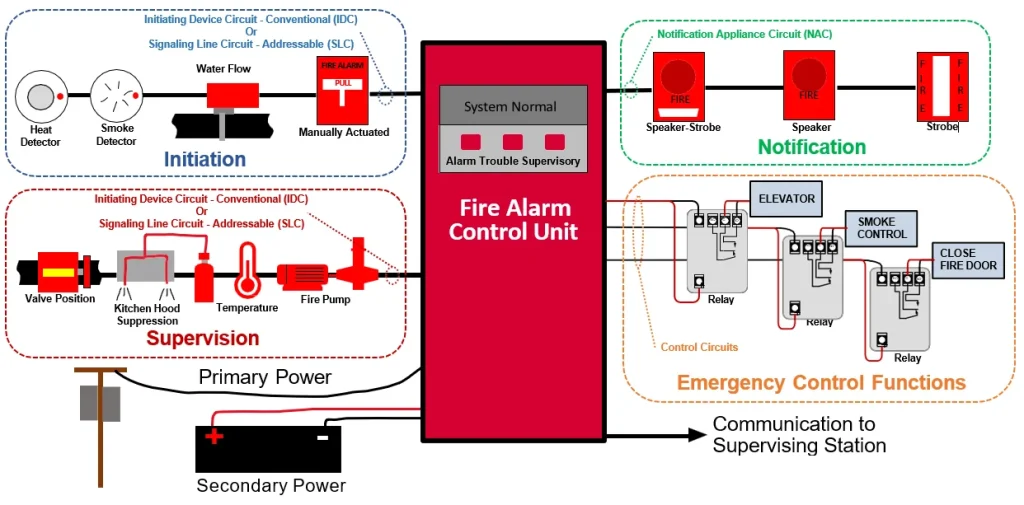
1. System Fundamentals

  • Primary Power: Normal utility source.
  • Secondary Power: Battery + charger or generator ensuring ≥ 24 h standby + 5 min alarm (Sec. 10.6.7.2.1).
  • Circuit Supervision: All initiating and notification pathways must detect opens, shorts, or grounds within 200 s.
  • Pathway Survivability:
    • Level 0 – no protection
    • Level 2 – 1-hour fire-rated
    • Level 4 – 2-hour fire-rated; used for high-rise voice systems.

2. Initiating Devices (Ch. 17)

  • Smoke Detectors: 9.1 m (30 ft) spacing on smooth ceilings (Sec. 17.7.3.2.3).
  • Heat Detectors: 15.2 m (50 ft) max spacing (Sec. 17.6.3.3.1).
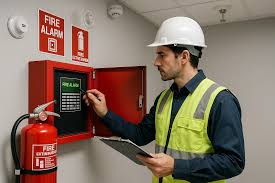
  • Manual Call Points: Within 1.5 m of exit doors, ≤ 60 m travel distance.
  • CO Detectors: Required near sleeping areas or fuel-burning sources.

Example Layout:
For a 900 m² open-plan office (height 3 m), detectors every 9 m × 9 m → 12 units total; pull stations at both stair exits.

3. Notification Appliances (Ch. 18)

  • Sound: ≥ 15 dB above average ambient or ≥ 5 dB above maximum.
  • Light: Strobes selected by room size / candela rating (Table 18.5.5.4.1).
  • Synchronization: Required when multiple strobes visible.
  • Voice Systems: Must meet intelligibility index (STI ≥ 0.45).

Example:
Corridor 20 m × 10 m, ambient 60 dBA → horns must deliver ≥ 75 dBA; use 24 VDC 75 cd horn-strobes spaced ≈ 15 m.

4. Control Units & Circuits (Ch. 23)

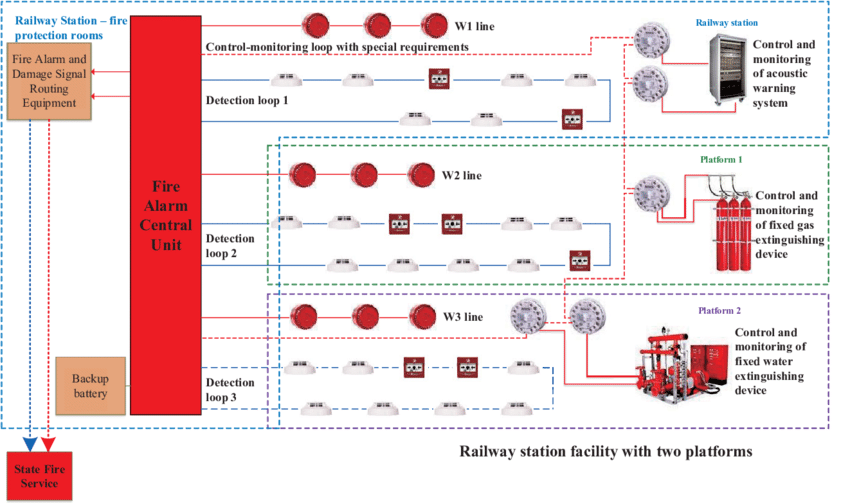
  • Class A Loop: Return path ensures continued operation after one open fault.
  • Class B Loop: Single-path wiring; devices beyond break disabled.
  • Recommendation: Hospitals, airports → Class A; small offices → Class B acceptable.

5. System Documentation (Ch. 7)

  • Floor plans with device IDs, riser diagrams, voltage-drop & battery calculations.
  • Record of Completion Form signed by installer & approved by AHJ (Sec. 7.4).
  • Maintenance & Test Records retained for system life (Sec. 7.7).

Sample Design Scenario
Project Type: 10-Story Commercial Tower, Karachi

Occupancy: Business / Mixed Use
Code Basis: NFPA 72 (2016 Ed.), Building Code of Pakistan 2016

Step 1 – System Type: Addressable FACP + Voice Evacuation.
Step 2 – Detectors: Approx. 200 smoke, 50 heat; spacing 9 m grid.
Step 3 – Notification: Horn-strobes in each office; speakers in corridors.
Step 4 – Wiring: Class A loops (2-hour fire-rated cables Level 4).
Step 5 – Power: 2 × 100 Ah batteries → 24 h standby + 15 min alarm.
Step 6 – Testing: 100 % functional test + voice message intelligibility check.

Compliance Notes:

  • Meets BCP §9.7.2.23 (business occupancies ≥ 3 stories).
  • Voice system satisfies §9.7.2.27 (high-rise).
  • Design drawings and test reports filed with local AHJ.

Maintenance & Inspection Essentials (NFPA 72 Ch. 14)
ActivityFrequencyPurpose
Visual inspection of devicesMonthly – QuarterlyCheck for obstruction/damage
Detector functional testingAnnuallyVerify response & signal integrity
Battery test (under load)Semi-annuallyConfirm standby capacity
Voice system speaker testAnnuallyVerify intelligibility

Tip: Use a digital maintenance management system (DMMS) to track logs and inspection intervals.


Integrating Fire Alarm Systems with Other Safety Systems
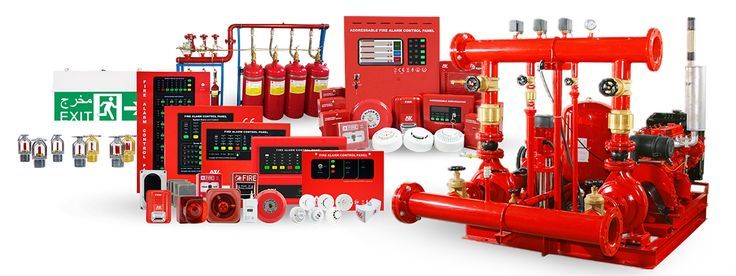
NFPA 72 (Ch. 21 & 24) supports integration with:

  • Sprinkler Flow Switches → auto-trigger alarm.
  • HVAC Controls → shutdown fans on smoke detection.
  • Elevator Recall / Firefighter Control.
  • Emergency Voice / Mass Notification linked to public-address systems.

Such integration is also recognized under BCP Clause 9.8 (Automatic Suppression Systems) and Clause 12 (Building Services Coordination).


Common Design & Installation Mistakes
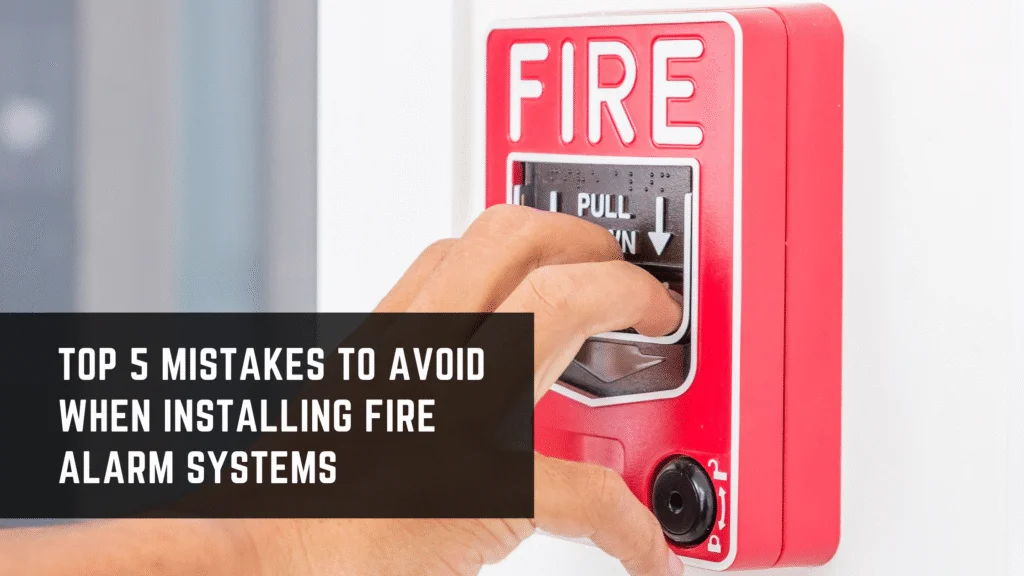
  1. Detector Spacing Errors: Ignoring ceiling height or airflow corrections.
  2. Improper Power Supply: Under-sized batteries or no standby reserve.
  3. Unsupervised Loops: No open/short fault detection.
  4. Strobe Overlaps: Causing visual confusion or trigger delay.
  5. Incomplete Documentation: Missing Record of Completion.

Preventive Action: Adopt peer review and factory acceptance tests before site installation.


Advancements in NFPA 72 (2022 Edition)

  • Cybersecurity (Ch. 11): Requires password protection, firmware integrity, and encrypted remote access.
  • Remote Diagnostics: Allows off-site troubleshooting under secure protocols.
  • Visual Inspection Tagging (Annex I): Color-coded tags (Green/Yellow/Red) for system status.
  • Digital Monitoring: Cloud-based supervising stations for multiple buildings.

These innovations are expected to influence future updates of the Pakistan Building Code.


Local Context & Implementation Challenges

  • Awareness Gap: Many installations use non-listed equipment without UL/EN certification.
  • Coordination Issues: Design drawings not shared with mechanical and electrical teams.
  • Maintenance Neglect: Batteries and detectors often un-serviced for years.
  • Regulatory Oversight: AHJ capacity varies by province.

Solution: Capacity-building by NFPAP and professional training on NFPA 72 implementation.


THIS POST SPONSERED By!
Excel Industrial Services (EIS): Supporting Code-Compliant Fire Safety

Excel Industrial Services provides complete solutions for NFPA 72 and BCP-compliant fire alarm systems, including:

  • System Design & Engineering per NFPA 72 and BCP 2016.
  • Supply of UL/FM-listed fire alarm panels and devices.
  • Installation and commissioning with certified engineers.
  • Annual inspection and maintenance contracts.
  • Integration with sprinkler, voice, and BMS systems.

Powered By EmbedPress

Example Projects:
Commercial complexes in Karachi & Lahore, educational institutions in Islamabad, and industrial sites across across Pakistan.

Key Strengths:

  • CFPS-certified personnel.
  • Compliance with NFPA 72 (Ch. 10–24).
  • Reports signed & stamped for AHJ approval.

Conclusion

Implementing NFPA 72 alongside the Building Code of Pakistan 2016 (Fire Safety Provisions) ensures life safety, property protection, and international-grade reliability in Pakistani buildings.

Architects, engineers, and facility owners must collaborate with qualified experts to design, install, and maintain compliant systems.

Excel Industrial Services (EIS) remains one of the top and most trusted sources in Pakistan for arranging and implementing fire alarm systems that fully comply with NFPA 72 standards and the Building Codes of Pakistan.

For expert consultation or system assessment, visit:
👉 https://eispak.com/fire-safety/fire-alarm-safety-systems/


HashTags#

#FireAlarmSystemPakistan #FireAlarmPakistan #FireSafetyPakistan #NFPA72Pakistan #BuildingCodePakistan #FireProtectionPakistan #FireDetectionPakistan #SmokeDetectionPakistan #HeatDetectorPakistan #FireAlarmInstallationPakistan #FireAlarmDesignPakistan #FireAlarmContractorPakistan #FireAlarmCompanyPakistan #FireAlarmServicesPakistan #FireAlarmTestingPakistan #FireAlarmMaintenancePakistan #FireAlarmInspectionPakistan #FireAlarmMonitoringPakistan #FireSafetyTrainingPakistan #FireSafetySystemPakistan #FireFightingSystemPakistan #FireAlarmSolutionsPakistan #FireSafetyAuditPakistan #FireAlarmEquipmentPakistan #FireSafetyConsultantPakistan #FireProtectionSystemPakistan #FireAlarmPanelPakistan #FireAlarmDevicesPakistan #FireSafetyStandardsPakistan #NFPA72CompliancePakistan #FireAlarmCodesPakistan #FireAlarmExpertsPakistan #FireSafetyEngineerPakistan #FireAlarmSupplierPakistan #FireAlarmDistributorPakistan #FireProtectionEngineerPakistan #FireDetectionSystemPakistan #FireAlarmContractPakistan #FireAlarmInstallationServicesPakistan #FireAlarmDesignServicesPakistan #FireAlarmNFPA72Pakistan #BuildingCodeFireAlarmPakistan #FireSafetyPakistanStandards #FireSystemPakistan #FireAlarmTestingServicesPakistan #FireSafetyInspectionPakistan #FireAlarmApprovedPakistan #FireAlarmULListedPakistan #FireSafetyAwarenessPakistan #FireDetectionAndAlarmPakistan #FireAlarmManufacturersPakistan #FireAlarmSystemKarachi #FireAlarmSystemLahore #FireAlarmSystemIslamabad #FireAlarmSystemRawalpindi #FireAlarmSystemMultan #FireAlarmSystemFaisalabad #FireAlarmSystemHyderabad #FireAlarmSystemQuetta #FireAlarmSystemPeshawar #FireAlarmInstallerPakistan #FireAlarmIntegrationPakistan #FireAlarmAndSafetyPakistan #FireProtectionAndSafetyPakistan #FireSafetyCodePakistan #FireProtectionEquipmentPakistan #FireAlarmControlPanelPakistan #AddressableFireAlarmPakistan #ConventionalFireAlarmPakistan #FireAlarmSolutionsEIS #ExcelIndustrialServicesPakistan #EISFireAlarmPakistan #EISFireSafetyPakistan #EISFireProtectionPakistan #NFPA72CertifiedPakistan #FireSafetyProfessionalPakistan #FireSafetyCompliancePakistan #FireSafetyEquipmentPakistan #FireDetectionEngineerPakistan #FireAlarmMaintenanceContractPakistan #FireSafetyContractorPakistan #FireAlarmSystemSupplierPakistan #FireProtectionConsultantPakistan #FireAlarmSystemDesignPakistan #FireSafetyImplementationPakistan #FireAlarmSystemCompliancePakistan #NFPA72TrainingPakistan #FireAlarmDesignEngineerPakistan #FireAlarmExpertPakistan #FireAlarmAuthorizedDealerPakistan #FireAlarmPanelSupplierPakistan #FireAlarmSystemNFPA72Pakistan #BuildingSafetyPakistan #FireSafetySolutionsPakistan #EmergencyAlarmPakistan #EmergencyCommunicationSystemPakistan #FireEvacuationSystemPakistan #SmokeAlarmPakistan #FireAlarmCertificationsPakistan #LifeSafetyPakistan #FireProtectionAuthorityPakistan
NFPA 25 Annual Fire Pump Performance Testing – Why, How And What

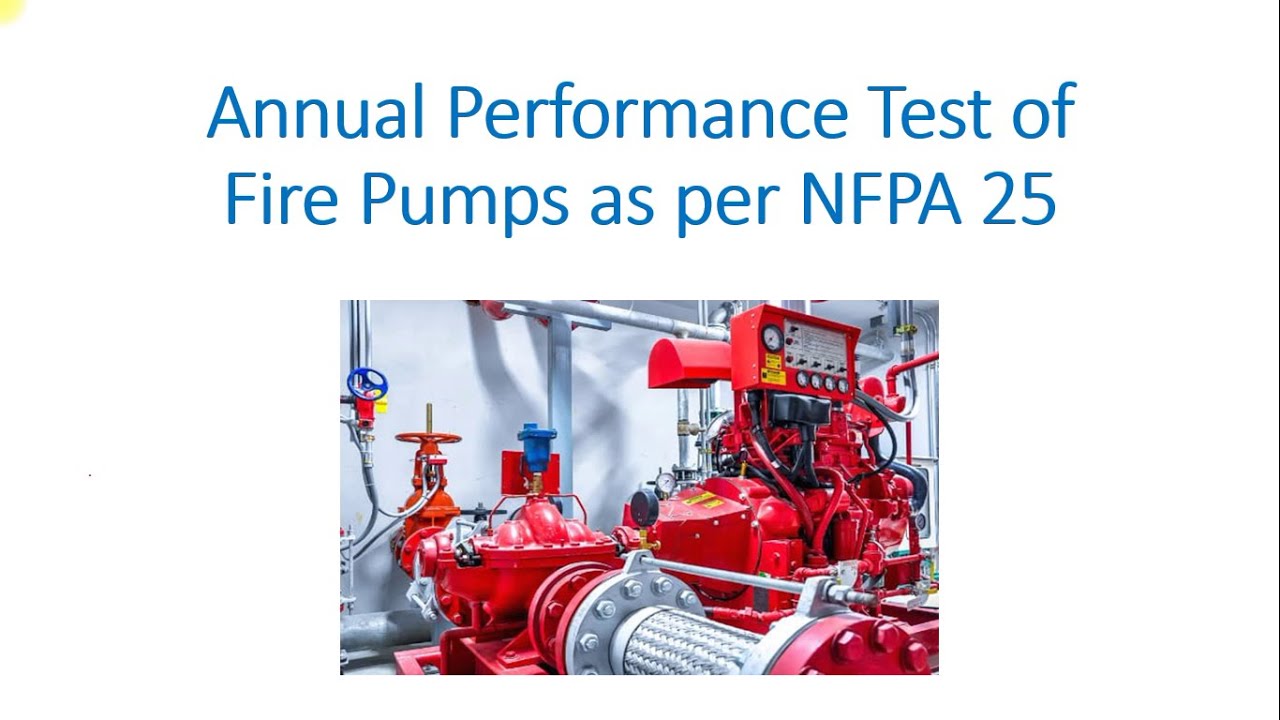
Fire pumps are complex systems that present one of the greatest testing challenges to contractors and field technicians. Unfortunately, many individuals tasked with performing these tests simply lack the necessary expertise. A botched-up fire pump test may fail to discover a major problem, or can result in unnecessary corrective work. The good news is that the necessary skills and knowledge are within the scope of a competent technician. This article attempts to highlight key aspects of properly performing an annual fire pump performance test. Its intent is to complement Chapter 8 of NFPA 25 (2023 edition).

Why Need to Do Annual Fire Pump Performance Testing As per NFPA 25

Fire pumps must satisfy the following performance goals:

  1. Start and run
  2. Supply the volume and pressure intended in the fire protection system design
  3. Initiate the necessary signals to alert responding personnel
  4. Keep running for the duration of a fire event.

Like any mechanical/electrical system that spends its life in standby mode, the system must receive periodic evaluation and testing to ensure that it has not been compromised by wear, age and the elements. If a fire pump fails to achieve any one of the above performance goals during a fire emergency, it will not adequately supply fire protection systems, the fire department will not have enough water, or both.

As an owner, your organization spent a lot of money installing and maintaining their fire pump system. You expect it to be available when needed, perform flawlessly and protect your assets.

As a contractor, you do not want to see a fire at your customers’ facility on the evening news after you just tested their systems. With that in mind, treat each performance test as if it was the last test before that fire.

How to Conduct Annual Fire Pump Performance Testing As per NFPA 25

NFPA 25, Inspection, Testing and Maintenance of Water-Based Fire Suppression Systems, as well as many state and local fire codes require that fire pumps receive an annual performance test. This is the most rigorous test the system receives between its commissioning and an actual fire. The goal of the annual performance test is a thorough test and evaluation of not only the fire pump, but of the entire fire pump system. As NFPA 25 states, this is to be performed by “qualified personnel”, but NFPA does not enumerate qualitative criteria for being “qualified”. Many jurisdictions require a fire protection contractor license to perform the annual performance test. Some jurisdictions require National Institute for Certification in Engineering Technologies (NICET) certification for field technicians to meet NFPA’s “qualified personnel” requirement.

In addition to properly performing the testing, the interpretation of the test results requires an understanding of hydraulic principles, centrifugal pumps, motors and controllers and is paramount to reach a conclusion as to the overall condition of the fire pump system.

The goals of the annual performance test are as follows:

  1. Comparing the field measurements against the certified pump curve.
  2. Ensuring that the fire pump system does not exhibit problems when operating under full load.
  3. Testing all ancillary systems to the extent possible in the field.

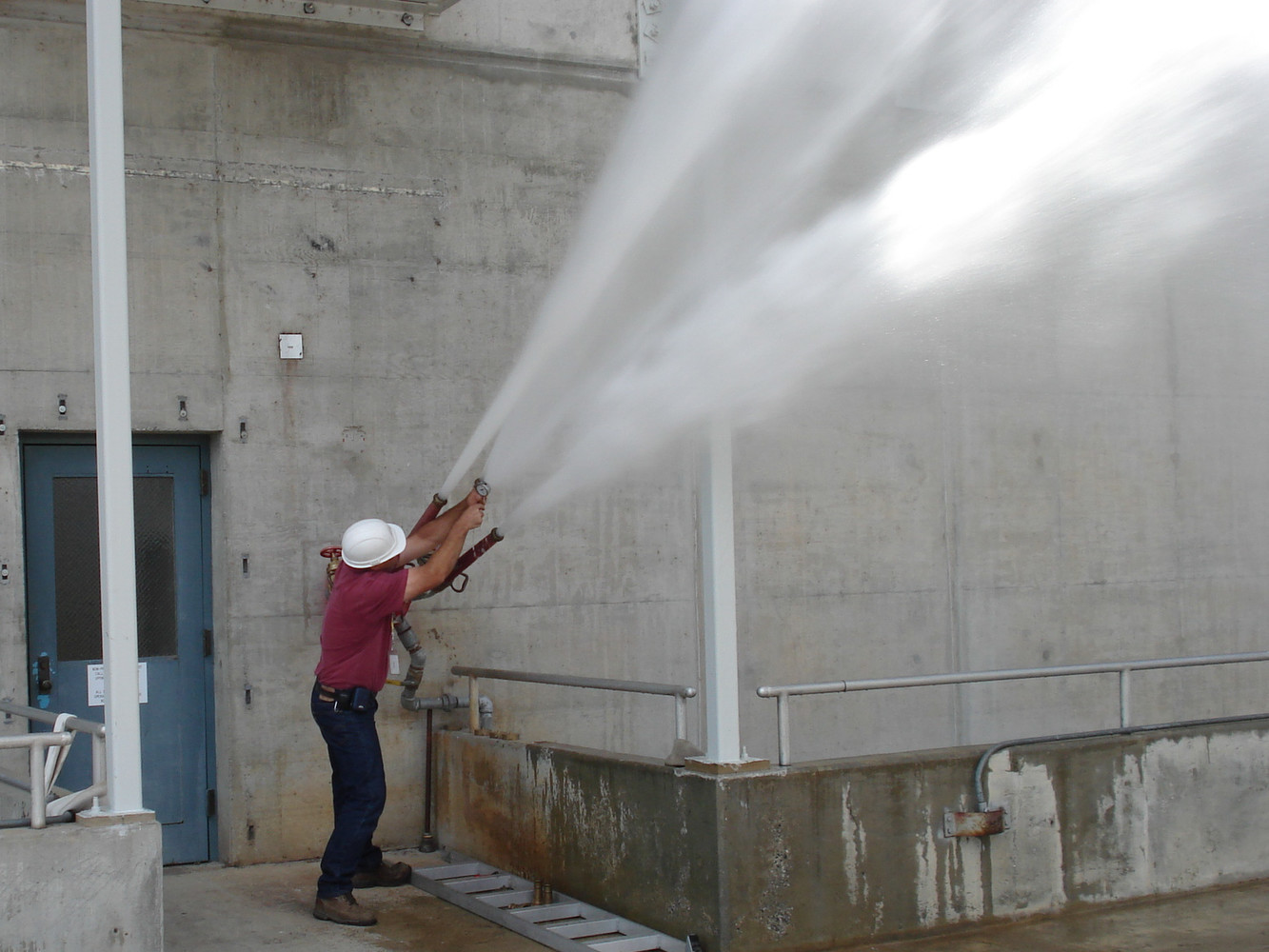
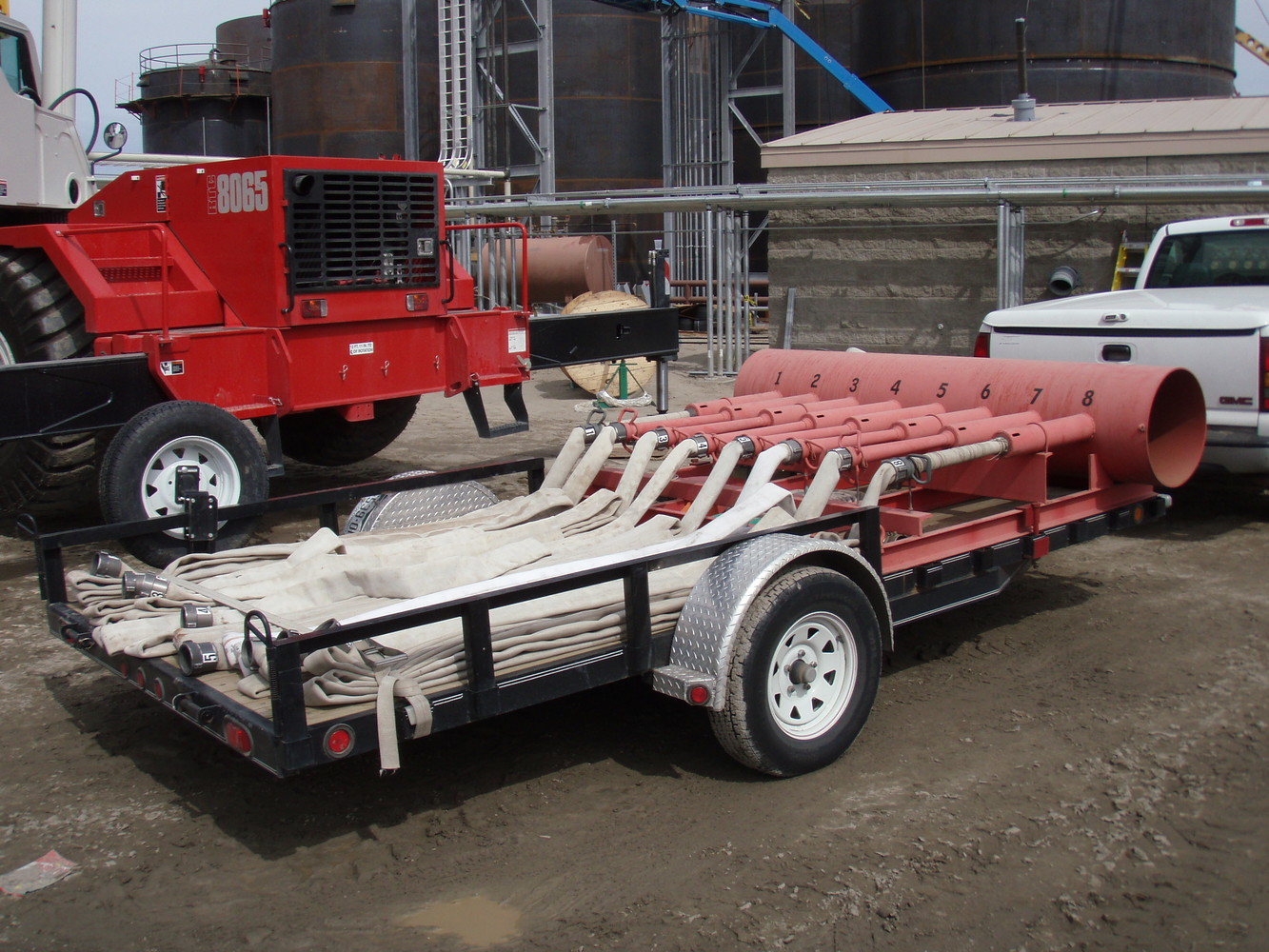
The proper testing of a fire pump system takes time and preparation. This includes ensuring that all measuring instruments are properly calibrated. NFPA does not set calibration standards, but industry practice for test instruments is at least annually. In addition, necessary measuring devices, such as smooth-bore nozzles, hoses, brackets, and common hand tools should be available. One or more assistants may be needed. Also, a qualified person able to perform simple testing on energized electrical systems should be on hand. The test comprises the following essential parts:

1. Start with a visual evaluation of the entire fire pump system to identify potential problems that could complicate the test or result in adverse conditions.

2. The automatic starting function should be tested. Determine whether the actual starting pressure is within the guidelines of NFPA 20.

3. The pump should be tested from churn conditions all the way to 150% of its rated capacity while taking the appropriate readings for each point. At least three points (churn, rated capacity and 150% of rated capacity) should be taken. Since these are nominal points on the pump curve, it is not necessary to measure flow exactly at 100% and 150%.

Measuring pitot pressures

4. If a recirculating flow meter is provided, NFPA 25 requires measuring the flow against pitot tube readings every three years. Many perfectly good fire pumps were needlessly overhauled because of erroneous flow meter readings. One method of performing a field calibration of the flow meter can be done relatively easily by measuring a flow rate between 100% and 150% of the pump rating (the higher the flow the better) with a pitot and then recording the corresponding discharge pressure at the pump. Then, adjust the flow rate through the flow meter until the same discharge pressure is obtained as earlier. The flow meter reading is then compared against the flow obtained with the pitot flow measurements. If both readings are within 5%, then the accuracy of the flow meter is acceptable and all other flow measurements can be taken through the flow meter. This method can also be used to verify the flow meter’s accuracy when unsatisfactory results are obtained.

5. After the readings are obtained at the 150% point, continue to let the pump run without decreasing flow as this places the greatest load on the system. Watch for overheated diesel engines, fuel system failures, and electric breakers tripping during peak conditions. NFPA 25 requires that electric pumps be operated for no less than 10 minutes and diesel pumps no less than 30 minutes during the annual test.

6. On electric pumps, voltage and current readings need to be obtained at the controller for each test point where a digital external gauge is provided. Voltage readings should be within 5% below and 10% above the rated voltage. If current readings exceed the rated amperage of the motor, the product of voltage and current must be within the product of the rated current and amperage times the service factor stamped on the motor nameplate.

7. The minimum necessary raw test data include suction and discharge pressures, flow rates and pump speed. Adjust the raw data points to the rated pump speed before plotting on the graph. Per NFPA 25, if the pump’s actual performance is more than 10% deficient, investigation and corrective action is required.

8. An area usually overlooked is the testing of fire pump controller alarm signals. For electric pumps, this usually includes pump running, power failure, phase reversal and loss of phase. For diesel pumps, this includes pump running, switch in OFF position, AC power failure, charger failure, high coolant temperature, low oil pressure, overspeed and failure to start. The procedure for testing these signals can usually be found in the pump controller manual.

9. Next, the emergency manual starting means should be tested. Electric and diesel pumps are provided with the ability to start the pump manually in the event of a total failure of the controller. Electric pump controllers usually have a manual switch and diesel engines have provisions for opening the fuel, establish coolant flow and crank the engine.

10. On newer computer-controlled diesel engines, the engine needs to be test-run on the alternate electronic control module (ECM) to ensure its functionality. Follow the instructions on the engine control panel to avoid engine damage from incorrect switching.

11. During the testing, attention should be paid to unusual noises, vibration and engine vitals. At the conclusion of the test, all valves and switches should be returned to their normal positions, one last automatic start sequence should be initiated to verify its proper operation and the facility fire alarm panel(s) should be checked to ensure that all signals are properly reset.

12. The fuel should be inspected and tested on diesel drives. At minimum, several gallons of fuel should be drained from the tank to remove water and contaminants that have settled to the bottom. Also, a sample of the fuel needs to to be collected and sent to a laboratory for testing per ATMS D975 to ensure that it is suitable for continued use.

What is Annual Fire Pump Performance Testing As per NFPA 25

The test report is an important document to owners, inspectors, consultants and other stakeholders. It is much more than a checklist or “certificate”. If the report and the data are thorough and accurate, it reflects positively on the tester and their employer. The report provides reassurance that the system is in good working order, or it can highlight problem areas that need to be addressed. If, however, the report is incomplete and/or contains bad data, the time and resources expended for testing were wasted. The test will have to be repeated, reputations are at stake and someone else may end up with the testing contract next year.

The annual fire pump performance test report should contain all raw and corrected data points, a list of all tested components and provide a final conclusion as to the condition of the fire pump system along with a section that describes any findings or deficiencies. The completed report must be accurate and complete enough to allow a technically competent reviewer to validate the conclusion based on your provided data.

A statement should be included as to the overall performance of the fire pump system, along with any findings and recommended corrections. If the pump does not meet the minimum requirements, it may need to be overhauled and a diagnosis should be included on the report to provide an indication to the repair concern.

If Something Goes Wrong

One of the reasons for testing any system is to identify weak links before it is too late. When something breaks or fails during a test, the test should not be viewed as the culprit, but rather as the successful discovery of a significant problem.

Safety

Fire pumps produce enough energy to inflict serious injury. This can be avoided by following good safety practices and awareness of the following:

No alt text provided for this image
  • If using hoses and nozzles for measuring flow, make sure that the nozzles are securely strapped. You don’t want them to come loose under pressure.
  • Particular care should be given to arc flash hazards when opening electric pump controllers. On older controllers without a digital readout, Volt and Amp readings needed to be measured with portable equipment, but NFPA 25 is moving away from this for safety reasons. Work inside controllers is best left to a qualified electrician wearing the appropriate safety gear.
  • Stay clear of lead-acid batteries. In rare cases, these can explode under a starting load.
  • Avoid standing alongside operating diesel engines. The sides are the weakest part of the engine block and internal moving parts can punch through them in case of a mechanical failure. Similarly, standing in the radial space around the flywheel should be avoided.
  • A diesel engine cooling system contains water at about 200 degrees F and 35 psi. This is enough to cause significant burns. There are many potential failure points (hoses, heat exchangers, caps, etc.). Avoid standing near them.

Common Shortcomings and Causes of Botched Tests

  • Failure to use calibrated measuring instruments
  • Incorrect recording of instrument readings
  • Inconsistent use of measurement units (i.e. psi versus feet of head)
  • Failure to correct pressure and flow for rated pump speed
  • Blind reliance on flow meter without using judgment for vetting results
  • Omission of overall conclusion as to performance
  • Pump performance is inadequate, but pump is still certified
  • Insufficient run time of pumps and drivers at 150% of rated flow
  • Failure to test emergency starting system
  • Failure to test alarms, supervisory and trouble systems

NFPA 25 Annual Fire Pump Performance Testing
by National Fire Protection Associates of Pakistan (NFPAP)

Ensuring Safety with Certified Expertise

The National Fire Protection Associates of Pakistan (NFPAP) is a leading organization committed to maintaining the highest standards in fire protection and safety. We are proud to offer NFPA 25 Annual Fire Pump Performance Testing services to clients across Pakistan and several Middle Eastern countries, including the United Arab Emirates (UAE), Saudi Arabia, Qatar, Oman, Bahrain, and Kuwait.

Comprehensive Testing Services

Our NFPA 25 Annual Fire Pump Performance Testing services are conducted by a highly qualified team of NFPA USA Certified Fire Protection Specialist (CFPS) professionals. This ensures that every aspect of your fire pump system is meticulously examined and tested to meet the stringent requirements of NFPA 25 standards. Our testing process includes a thorough evaluation of the fire pump’s performance, including flow, pressure, and operational reliability, ensuring that your system is fully functional and ready to protect your property and personnel in the event of a fire emergency.

Globally Recognized Reporting

Upon completion of the testing, NFPAP provides detailed reports that are duly signed and stamped by our certified CFPS personnel. These reports are not just comprehensive; they are also recognized and accepted by worldwide authorities, giving you the peace of mind that your fire protection systems are in compliance with global safety standards.

Serving Pakistan and Beyond

NFPAP is dedicated to extending our expertise beyond the borders of Pakistan. Our services are available in key Middle Eastern countries including the United Arab Emirates (UAE), Saudi Arabia, Qatar, Oman, Bahrain, and Kuwait., where we bring the same level of dedication, precision, and professionalism to ensure that fire pump systems are in optimal condition and compliant with international standards.

Why Choose NFPAP?

  • Expertise: Our team comprises certified professionals with extensive experience in fire protection and safety.
  • Reliability: We adhere to NFPA 25 standards, ensuring that your fire pump systems are tested thoroughly.
  • Recognition: Our reports are recognized by authorities worldwide, ensuring compliance and acceptance.
  • Geographical Reach: We serve not only Pakistan but also key Middle Eastern countries, making our services accessible to a broader client base.

Choose NFPAP for your NFPA 25 Annual Fire Pump Performance Testing needs and ensure the safety and reliability of your fire protection systems with globally recognized certification.

For Queries Plese feel free to contact us!

WhatsApp: +92 345 3230843
Email: gu***@*****ak.org

The views expressed in this article are those of its author and in no way represent the positions and views of past, present and future employers, clients or affiliates. This article is for informational and educational purposes only. Recommendations or conclusions in this article should not be interpreted as any guarantee that the reader will achieve the same results.